Body of Evidence
August 8, 2026
How one actor and producer is using stage and screen to say the things doctors, workplaces, and families still won’t.
There’s a moment Esme keeps coming back to. She’s in agony at home, no painkillers left, and she calls her dad. Bring ibuprofen. Bring a lemon — it helps with the nausea. He arrives, sees how bad it is, and calls an ambulance. She tells him he doesn’t need to. The paramedics, when they come, are gentle but blunt: you can come with us, but you’ll spend seven hours in the waiting room before we send you home anyway.
“It was interesting — someone else seeing something that’s so normal for me,” she says. “That’s why it feels so normal, because we have it so much. That ten pain actually becomes a four pain, because we’re so used to it. But someone else, they’re like, oh my God, this is so bad.”
The space between what chronic pain patients have learned to normalise and what it actually is sits at the centre of everything Esme makes. She’s a writer, performer, and founder of an independent production company. Esme’s own diagnostic journey has spanned PMOS, a still-unconfirmed suspicion of endometriosis, a contraceptive implant that “ruined my mental health,” and years of being told, in various ways, to wait.
The work began almost by accident, in an online scratch show during the last UK lockdown. It was a feminist project, meeting twice weekly, talking often about period problems Esme had been quietly living with and just as quietly ignoring. The regularity of the conversation did something: it made the ignoring impossible.
Driving home from an unrelated rehearsal, she had what she describes as her first real creative idea: a play about a girl talking to her missing egg, written with two friends. At a preview, an older audience member — a grandmother — told them, “I went through this. My daughter went through this. My granddaughter is going through this. And it’s still not spoken about in schools.”
That response became the seed of Evulve Productions, the company Esme co-founded to keep making work that teaches through story what school, medicine, and family often don’t. Since then, the slate has grown to include a play called Rotten Fruits, a short film proof-of-concept for a pilot version of it, and a web series called Boof.
Rotten Fruits follows a mother and daughter and their fractured relationships with their own bodies, and with each other. Esme is careful about what the title is doing double duty for.
“It says two things,” she explains. “It’s rotten fruits, as in the rot between the mum and daughter’s relationship and their generational shame — you know, like apples; an apple doesn’t fall far from the tree.
“But then also, the female genitalia is often compared to a wide variety of fruits, and I’ve seen so much imagery of mouldy pomegranates leaking period blood. So for me it also says their health is rotten, both characters, and they don’t really know it.”
At its core, she calls the play “a cautionary tale of the importance of listening to ourselves, and not inheriting generational shame.”
Boof is a project that inverts the usual framing. Produced by Imposter Productions in association with Evulve, Boof is a web series set in 2016, told from the perspective of a wellness influencer at the height of the industry’s misinformation era — auras, cleanses, certainty. But the story’s real engine is her assistant, Lucy, who never appears on screen and who is quietly, urgently trying to get a diagnosis for pain she can’t yet name.
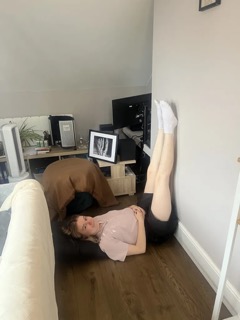
Esme plays her. “We see glimmers of this character,” she says. In one scene, Lucy is barely in frame, legs up against the wall behind her employer’s desk. Asked what she’s doing, she can only say it helps — she doesn’t fully know why, only that she found the trick online, half-explained, the way so much period-pain management gets passed around: a stranger’s TikTok, a fragment of physiotherapy logic, no doctor in sight.
“It’s not a big part of the story, not a catalyst for anything,” Esme says. “But it’s something I do every day.” It made lead creator Jessica Munna’s final cut anyway.
The contrast — a well-lit influencer performing wellness, an unseen woman in real pain a few feet away — is the argument the whole project is making.
Esme’s own path through the healthcare system was fast to begin with, and then it became agonisingly slow. An early scan suggested up PMOS, a diagnosis delivered with the line “this probably means you’re going to struggle with fertility”. She sat in the car afterwards, not really knowing what to do with that.
Eighteen months and no follow-up later, Esme’s symptoms had worsened. She changed her exercise routine, giving up running for yoga and walking, and — against expectations — got her periods back. A clinician then told her that meant she no longer had PMOS, before another contradicted that entirely.
The next doctor pondered endometriosis, and offered the pill as a fix. Esme, by then well-versed from two years of research and two full-length writing projects on the subject, pushed back on this idea and leaned more towards proper investigation first.
Eventually, they settled on a coil, which has caused its own problems. Now, Esme is pursuing further investigation through her partner’s private healthcare. This is a route she’s clear-eyed about.
“It’s a bit of a double-edged sword,” she says. “It’ll be great if I get my answers and start feeling better quickly. But it’s frustrating knowing that the NHS is in a situation where there’s not enough knowledge about things like endometriosis, that it takes so long to even get listened to. And if I wasn’t fortunate enough to be with someone who has private healthcare, I wouldn’t get the answers as quickly.”
When fertility becomes the whole conversation
One thread runs through nearly every conversation Esme has had with doctors, and through both of her major stage works: the moment a health conversation quickly but quietly becomes a fertility conversation, whether that’s what the patient asked for or not.
“The first thing my doctor said to me is that this might mean you’re not able to have children,” she recalls. “I was like — woah, that’s not even what I’m thinking about right now. I’m in chronic pain every day. What I want you to tell me is how do I manage this. Can I have stronger painkillers? Is there medicine I can be on? What’s the next step?”
Both of Esme’s plays carry that same through-line — a character whose fertility becomes the central subject of everyone else’s concern. “I understand why it’s part of the conversation,” she says, “but it becomes the whole conversation. And that’s because of patriarchy — seeing female bodies as incubators, rather than bodies that need to survive outside of childbearing.”
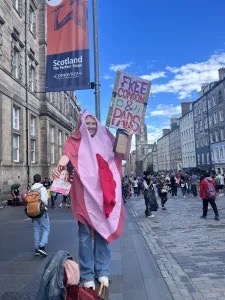
With a pilot version of Rotten Fruits now in development alongside the original play, Esme has thought carefully about why the same story needs to exist in two mediums.
“Theatre people can really love theatre, film people can really love film,” she says. “Theatre lets you have so much fun, because the audience is right there and you can play with them. Film has its own magic — we’ve got a moment in both versions where a character has this huge career moment, she’s interviewing someone, and she realises she’s bled through her white suit onto a white sofa. That’s her turning point, where she has to start listening to her body.”
She’s also candid about the ways fringe theatre — often the only place stories like hers get staged at all — gets dismissed. She references the backlash to a wave of feminist work at the Edinburgh Fringe, mockingly branded “Femi Fringe,” later reclaimed by F-Bomb Theatre as a badge of honour rather than an insult.
“Sometimes people take film more seriously, because they see theatre through that lens,” she says. “I’d love to get stories like this out of fringe and onto bigger stages. But we’re in a cycle of retelling stories we’ve already heard, and we need to break out of that before new stories get let in.”
Asked what she hopes audiences carry out of a screening or a performance, Esme doesn’t reach for a statistic, though she does have them ready. What she wants is smaller, smarter, and more achievable: for someone to remember the work the next time a colleague calls in sick with period pain, and to withhold the comment, the eye-roll, the assumption.
“I’d love people to leave with more compassion,” she says. “I think we can be more compassionate about so many things, but especially this, because it affects so many people — it has the possibility to affect over half the population. Compassion is just so key to it being more normalised, in every area of society, including medicine.”
And if she could put one audience in front of the work — no wrong answer, she’s told, whether it’s teenage girls or men — her answer goes somewhere unexpected.
“I would love the people in power, the people who make decisions for all of us, to watch and understand. Because then it trickles down and benefits everyone.”
A Youngish Perspective
May 26, 2026
Blurred Lines is a feminist, queer-led short film, starring Emmerdale’s Matthew Wolfenden, that explores the impact of county lines through a feminist horror lens. Written by a Grimsby-born creative who has witnessed the effects of exploitation first-hand, the social issue film follows a queer teenage girl groomed into a drug gang, blending social realism with psychological horror to reveal the blurred boundaries between protection and control.
Blurred Lines is about to start it’s festival run, updates can be found:
Via this website
On Evulves Instagram: @evulveproductions
On Blurred Lines Instagram: @blurredlinesshortfilm_
County lines stories have been told before, but rarely through a queer, female lens — why do you think the industry has consistently missed this angle?
Becki: Within the media, particularly in TV, there is an extremity of creating generic stories around the themes of County Lines. There is an oversensationalism of working-class people on our screens and a stereotypical portrayal of queer experiences. Therefore, I think that’s why the industry misses their narratives, as it relies on creating stories for dramatic effect rather than the need for representation or consideration for those involved. With the Television industry still lacking in diversity these types of stories aren’t getting told as there is still a lack of understanding regarding why these stories are important or how they can be used as educational tools. Therefore, I hope Blurred Lines can be used to steer the industry in a more truthful narrative.
Esme: In my early twenties I was a support worker for female care leavers, in a county lines area, and many were at risk of being groomed into gangs. And I kept thinking: how do you truly teach someone that the person who’s been nice to them is actually dangerous? The conversation in the media is still centred too narrowly – focussing on young men from London – and the queer dimension is almost entirely absent. Blurred Lines doesn’t just centre women – it centres queer young women, who are an underrepresented group both in society and especially in how these stories get told.
Esme, how did Evulve’s mission shape the way this film was actually made, both in front of and behind the camera?
It shaped almost every decision: behind the camera, we ask everyone’s accessibility needs before we shoot – making sure there are chairs for people who need them, food throughout the whole day, that everyone actually feels taken care of. That might sound small but it changes the energy on set entirely, and it’s non-negotiable for us. In front of the camera, we made a conscious choice to cast people with a genuine connection to the story. Becki is from Grimsby and wrote from lived experience of witnessing county lines in the north of England. We cast Matthew Wolfenden —-who people will know from Emmerdale – partly because he’s northern, and he speaks in the making-of documentary about his own knowledge of county lines issues coming from up north. That mattered to us because so much of the media conversation about gang crime is London-centric, but county lines activity happens all over the country. Gangs relocate, they find quieter bases, they move into areas that don’t make the news. We wanted to tell this story honestly, and that meant the people telling it needed a real relationship to it.
The film blends social realism with psychological horror, how do you make sure that framing serves the story rather than sensationalising it?
Esme: It comes from truth rather than fabrication. This isn’t a story that was constructed from an idea – it comes from research, lived experience, and people who know this world. I think when the material is rooted that way, the tone tends to follow. There’s a closing shot in the film that I think captures exactly what we were going for – the camera looks right down Ellie’s eyes, and it just pulls you completely into her world. That’s not horror for the sake of horror, but an invitation to understand her. Every visual choice was made in service of staying with Ellie, keeping the audience inside her experience rather than watching it from a distance.
Becki: When writing the first draft of Blurred Lines, I wasn’t paying attention to what genre the film was going to be. I was focused on how to tell the story with authenticity and truth. With Blurred Lines being a character driven piece that avoids being another generic psychological horror film. In addition, the script isn’t in chronological order and it was on purpose as I find when people tell traumatic stories to other people they don’t tell it chronologically as the person remembers other details or something distracts. So when following Ellie, I wanted the film to feel like it’s from her, truly, and following how she would remember events.
The cost-of-living crisis runs underneath this as a real driver of vulnerability — who do you most want to see this film, and what do you want them to do with it?
Esme: Policymakers, would be amazing- we’re already working with Stevenage Borough Council and Friends of SADA – a domestic abuse charity doing significant work for people with experiences of domestic violence – and those relationships came directly from making this film! Those conversations need to happen at every level.
Becki: Like Esme said, we want Policymakers to see this film. With everything becoming more unaffordable the rise in crime and gangs is exceptional. However, nobody really seems to care; therefore, we want this film, on every level, to start conversations about what can be done to help people who need it.
What do you both hope Blurred Lines changes?
Esme: The cost-of-living crisis is making more young people vulnerable and more susceptible to being drawn into situations like this, because they don’t feel like they have other options. I want them to watch this and know that they do. I want everyone who watches it to walk away with more compassion – for the person they read about in a headline, for the young woman they might see on the street and not understand. That’s the thing that changes behaviour more than any campaign- compassion.
Becki: There’s a lot of things I want Blurred Lines to change. Blurred Lines highlights how hard it has been and currently is for single parents. Ellie’s mum is a Nurse, a job which is highly respected yet the pay for decades has been disproportionate to how hard the job is. Ellie’s mum should be able to afford having a family by herself but she can’t. I want the government to provide more help for working single parents with more than 25% off council tax (why it’s not 50% i’ll never understand!). Furthermore, I want victims of County Lines to know there is a way out. Too often people involved feel trapped with no way out, but this isn’t the case as there’s amazing organisations that do help like St Giles charity. Blurred Lines also creates more truthful representation for queer women and I want them to feel less alone and confused.
Bold Journey
April 30, 2026
We recently had the chance to connect with Esme Michaela and have shared our conversation below.
Esme, a huge thanks to you for investing the time to share your wisdom with those who are seeking it. We think it’s so important for us to share stories with our neighbors, friends and community because knowledge multiples when we share with each other. Let’s jump in: Who are you learning from right now?
I’m learning a lot from Carrie Green, the founder of the Female Entrepreneur Association. Her work has completely reshaped how I see myself as a founder and CEO. She helped me step into the identity of a leader, not just a creative, and gave me permission to think bigger before I felt ready. Beyond Carrie, I’m constantly learning from the emerging artists and collaborators I work with at Evulve Productions; seeing their courage, fresh ideas, and perspective on the arts reminds me that growth is a collaborative journey, and that inspiration can come from anywhere, at any time. One particular creative that I’ve been working with is Becki Douglass, and I am constantly learning from her bold moves and self belief.
Can you briefly introduce yourself and share what makes you or your brand unique?
I’m Esme Michaela, an actor, producer, and founder of Evulve Productions- a feminist arts company creating intersectional, queer-led work across film, theatre, festivals, podcasts, education, and media. We exist to tell stories often excluded from mainstream cultural, media, and educational spaces, while also changing who gets access to the creative industries.
At our core, we develop and produce original short films, theatre, live events, and digital content- that reflects feminist, queer, and socially engaged storytelling. Alongside our projects, we build structured pathways for emerging creatives through initiatives like Film Dreamers, supporting first-time filmmakers from idea to production. This year, we’re launching Femi Fest: The 24-Hour Theatre Festival, connecting theatre makers with industry professionals and creating real pathways from grassroots creativity to careers. In May we are launching Popcorn & Patriarchy, a podcast combining film critique through a feminist lens with creative challenges and mindset discussion.
Ultimately, Evulve is more than a production company; it’s a platform and ecosystem for underrepresented voices in the arts. Everything we do- from producing work to developing courses, festivals, and podcasts- is designed to empower creatives, foster community, and make culture that is both meaningful and accessible. More recently, Evulve Productions has been recognised as a finalist in the 2026 UK StartUp Awards, in the creative sector, which feels like a meaningful marker of how far the company has come in building both creative work and real industry pathways for underrepresented creatives.
Alongside building Evulve, I’ve worked as a producer on socially engaged films including The Orphan, which gained over one million views online and was screened at the Palace of Westminster, bringing conversations around grooming and exploitation directly into political spaces.
Thanks for sharing that. Would love to go back in time and hear about how your past might have impacted who you are today. Who taught you the most about work?
My first drama teacher, James, had a lasting influence on how I approach creativity and work. He taught me that discipline and focus are important, but that true magic happens when you allow yourself to play, explore, and enjoy the process. From a young age, that balance of fun and structure shaped how I perform, produce, and mentor others. His guidance instilled confidence, curiosity, and a belief that creativity thrives when you feel safe to experiment and those lessons are central to everything I do at Evulve and wishing my creative practice as an actor and producer today.
When did you last change your mind about something important?
I used to define myself entirely as an actor, thinking that booking work meant proving my worth. But I shifted my mindset and stopped being desperate for validation. Once I embraced producing, creating, and connecting other artists, opportunities started flowing naturally. By letting go of the idea that acting alone defined me, I booked my agent, started producing projects, and expanded Evulve Productions into a platform that supports underrepresented voices. That moment taught me that sometimes, stepping back and seeing the bigger picture creates more opportunities than pushing harder ever could.
Sure, so let’s go deeper into your values and how you think. What’s a belief or project you’re committed to, no matter how long it takes?
I’m committed to creating equitable pathways for underrepresented creatives, no matter how long it takes. Projects like Femi Fest and Film Dreamers aren’t just about producing work, they’re about providing real access, mentorship, and visibility for people who often face systemic barriers. I believe in building an ecosystem where feminist, queer, and socially engaged storytelling thrives, where artists can go from first idea to first opportunity. It’s about persistence, values-led growth, and proving that inclusion and artistic excellence aren’t mutually exclusive- creating work that not only reaches audiences but also enters spaces like Parliament, where real change can happen.
Thank you so much for all of your openness so far. Maybe we can close with a future oriented question. What do you understand deeply that most people don’t?
I’ve learned that success in the arts is not just about talent or exposure, it’s about resilience, relationships, and creating infrastructure for others. Most people focus on the finished product, but real impact happens behind the scenes: mentoring emerging artists, building pathways into the industry, and sustaining spaces where creativity can flourish. Evulve isn’t just a production company; it’s a platform that proves when you design opportunities intentionally, you can change who gets to create, who gets seen, and whose stories are told.
Contact Info:
Website: https://www.evulveproductions.com/
Instagram: https://www.instagram.com/evulveproductions
Other: Evulve Productions:
TikTok: https://www.tiktok.com/@evulveproductions
Esme Michaela:
LinkedIn: https://uk.linkedin.com/in/esme-michaela
Website: https://www.evulveproductions.com/esme-michaela
Your Purpose DNA
April 23, 2026
As I’ve gotten older and experienced more things – more life – I’ve realised that my purpose is so much more than one thing, or a single career path. I think people who are passionate about the arts are led to believe that we all have a sole purpose in life, intrinsically connected to our creative goals; however, I think we are all so much more than that.
Growing up as a Creative
Growing up, I always thought that my purpose was to act, to tell stories, to entertain, to be of service, because that’s where my passion has always lain. Starting at my local drama club, Spotlites Theatre in Chatham, at the age of 4, I quickly learned that I loved using my imagination, performing for others, and for my own enjoyment.
Being on the stage began to feel like home. The warmth of the stage lights, the smell of the smoke machine chugging out ambience, all eyes on me.
When I was 17, I performed in an amateur dramatics version of Assassins by Stephen Sondheim, portraying a character who’d truly lived in history. Being able to explore and research a side of someone, and events that had actually transpired, inspired me to focus my practice on stories from history that may not have been deemed important enough to tell, and shed light on stories from underrepresented groups within society.
This is something I now explore through my podcast, Popcorn & Patriarchy, where we critique films through a feminist lens and talk about the creative process and mindset struggles. The aim is to help listeners unpack their feelings about their favourite films, while growing within their own creative practice.
As I started to explore other parts of the industry, I found that same love and desire also extended to acting in front of a camera, as well as producing film – into shaping a project from concept to completion. Something that stayed with me, was the passion for telling stories.
That is precisely what has led me to work on impactful projects such as The Orphan, a film highlighting the dangers of grooming within county lines. It reached over 1 million views on YouTube within its first two months of release, and I helped take it to the Houses of Parliament for a screening.
Founding my Business
When I was around 8 years old, I used to buy fruit from the Big Tesco and re-sell it around my village for a profit – schemes that lit a fire in my brain, working out numbers and patterns.
I was able to reignite my passion for business in 2022 when I first began producing, and was inspired to start my own production company – but with a stronger ethical grounding than buying Tesco fruit and re-selling for profit.
Through Evulve Productions, I’ve been able to combine my passion for creating theatre and film that matters, with my love for business. Alongside developing our own work, I now dedicate my time to helping others create their short films through our programme, From Film Dreamer to Filmmaker – breaking down access barriers within the industry and supporting creatives to go from idea to execution.
I truly felt I had finally stepped into my purpose; I was able to lift others up through the arts, perform, work on projects from start to finish, and play around with all the spreadsheets. But that got me thinking – this didn’t start with Evulve or acting, it’s always been there. Even when I was making anti-smoking flyers as a child and handing them out at our village fête because I thought that would help prevent global warming.
Finding my purpose
If everything changed – and I’m talking apocalyptic changes – would my life purpose be tied to my career? I don’t think so. And let me tell you, after tying my whole self-worth to my creative passions since the age of 4, this was a revelation!
I then started thinking about what it really is that I’m trying to do – and have been trying to do for the last 23 and a half years. I’ve wanted to make people smile through performing, help people feel seen through telling stories that marginalised groups can finally see themselves in, and run my business ethically. That work is now being recognised by institutions such as the UK StartUp Awards, where Evulve has recently been named a finalist in the 2026 Creative Sector, highlighting our work in building new pathways into the creative industries and reshaping who gets access to create within them.
Like others, I have also struggled with imposter syndrome, constantly feeling like I needed to achieve more before I could call myself successful. But redefining success as impact, both creatively and personally, changed everything.
When it boils down to it, I’ve always wanted to change people’s lives for the better. Whether that’s the creatives I support, friends, family, clients, or audiences – if I can change one person’s life in a small way, then I’ve done my job. I’ve fulfilled my purpose.
So, I invite you to consider- if your career was taken away tomorrow, what would still give your life purpose?
By Esme Michaela
Actor, Model, Producer, Founder of Evulve Productions
Esme Michaela Bio:
Esme Michaela is a London-based producer, actor, model, and founder of Evulve Productions, represented by Inclusive Talent. She creates across film, theatre, podcasts, and live events, building bold, intersectional storytelling while opening access routes for underrepresented creatives. Her work blends artistry with industry insight, ensuring culture is shaped by diverse voices and lived experience.
Esme Michaela: https://www.evulveproductions.com/esme-michaela
Popcorn & Patriarchy: https://www.evulveproductions.com/popcorn-patriarchy
From Film Dreamer to Filmmaker: https://www.evulveproductions.com/beginner-film-maker-course
Evulve Productions: https://www.evulveproductions.com/
SME Magazine
March 6, 2026
Esme Michaela, Evulve Productions
“One of the biggest lessons I’ve learned as a female founder is to find your niche and commit to it, but allow yourself to evolve. When I started, I didn’t try to be everything to everyone. I focused on qualified guides, safety and building confidence in the outdoors. That clarity created trust.
At the same time, business is rarely linear. You have to adapt, test ideas and respond to what your community actually needs. Stay true to your values, but flexible in your approach. Growth doesn’t come from copying others, it comes from building something that genuinely reflects who you are.”
Bold Journey
May 14, 2024
Alright – so today we’ve got the honor of introducing you to Esme Michaela . We think you’ll enjoy our conversation, we’ve shared it below.
Hi Esme, appreciate you sitting with us today to share your wisdom with our readers. So, let’s start with resilience – where do you get your resilience from?
To me, resilience is the ability to keep moving forward, even in the face of adversity, even when I might not really want to. “We didn’t come this far just to come this far” -Matthew Reilly, The Three Secret Cities (I haven’t read this book, I saw the quote on Instagram)
It’s funny because, as one of my side jobs, I teach disadvantaged young girls life skills such as boundaries, self esteem and resilience, and this was where I learned what the word really means- and that it’s a quality I pride myself in having.
As cliché as it sounds, my Mum always instilled a strong work ethic in me, telling me not to give up unless I had tried the very most that I could. As a child that dreamed of becoming an actor/ business woman, this stuck with me in every production I performed in and every hustle I embarked on, including buying fruit and veg from Tesco and reselling it for profit around the village.
Applying for, and getting rejected from drama schools was the first time my resilience was put to the test in my adult life. Eventually I received a full scholarship from The New York Film Academy, where I studied Acting for Film. Being this far away from home was exceptionally difficult for me and my mental health declined rapidly, as I reached my final semester I realised I was sick with an eating disorder, something that I had been struggling with many years. The first person I told was my Mum, who asked me if I wanted to come home, to focus on recovery. I thought back to my favourite quote and kept on moving forward. I couldn’t have done this without the support of my friends back home and in New York. Unfortunately my drama school experience was cut short due to the first Covid 19 pandemic, meaning I had to move home early.
Through this time my resilience was really tested, staying in a stressful living environment and dealing with the uncertainty of lockdown. Here I wondered most if I should change careers, retrain in something more reliable. I think the main reason I didn’t was because of this weird deep down desire I have to succeed in whatever way I feel is succeeding- and giving up due to Covid was not on the cards for me.
After over a year of lockdowns, with acting roles being hard to find, I decided to take matter into my own hands by co-creating a show, based on my own diagnosis of a hidden disability, and taking it to the Edinburgh Festival. Through my hard work I managed to get an acting agent, around the same time that I founded my production company, Evulve Productions. Staring this company felt like the final culmination of all of my experiences, creating performances about my mental health issues and physical disorders. Things started feeling like they were paying off when I was evicted which resulted in me, my partner and our two cats, becoming homeless. Again, my resilience was put to the test. I still dedicated myself, daily, to my career however due to my personal circumstances opportunities I was given and created were falling through- unfortunately despite how hard I tried I couldn’t give my best self to anyway whilst I was living in such uncertain circumstances- again. Because of this I sadly lost my agent.
It seemed as soon as things in my personal life started looking up, things in my business did too- fundraising for our LGBTQ+ short film starting picking up, we held successful events and our team grew quickly. I wholeheartedly thank this success on my support system, my friends, Mum and girlfriend who constantly believed in me through this hard time. Without them I worry my inner resilience may not have been enough.
Now, due to the Libra in me this still wasn’t enough- now I wanted to start making strides in my acting career again. So, I did what I do best and made countless lists in my Filofax and formulated a plan of action.
Since then I have found myself emailing performing in-front of industry professionals monthly, auditioning for companies I have long admired and bettering my craft by attending acting classes. At the time of this interview I am still searching for a new agent and my resilience definitely still gets tested but I try to stay true to myself and my core values. And when I’m feeling like I do want to give up I am fortunate enough to have my Mum, partner and friends there to remind me to keep on going.
Let’s take a small detour – maybe you can share a bit about yourself before we dive back into some of the other questions we had for you?
As aforementioned I am the founder of Evulve Productions, an education arts production company that creates theatre, film and resources about feminist topics that might not otherwise be taught in educational institutions.
We are currently in preproduction/ fundraising stages for a short film ‘Love Wins’ that tells true stories from those within the LGBTQ+ community from over the past one hundred years. This film is so important as it will serve as a reminder that queer people, such as myself, have been around forever- a key message in light of LGBTQ+ rights being stopped all over the globe. We are currently selling Queer Barbie themed stickers to contribute to our fundraising.
We are also in the very early stages of our next project, which is a theatre and film project that tells the story of a woman in her late twenties, who finally confronts her period problems. Through this journey we watch as her relationship grows with her menopausal mother. We are super excited about this project and encourage anyone who has experience ovarian or Menstrual health issues to follow our socials to look out for opportunities to get involved.
My company is so important to me as it is a place where I can stretch my creativity and work on pieces that otherwise aren’t being made for people like me. I also find it important to give other marginalised people the opportunity to work along side me.
As you will have gathered being an actor is a very important part of my identity, and has fueled my whole journey and life. Because of the mindset I’ve mentioned to you I’ve started putting myself out there to new opportunities, that I used to be too scared or intimidated to do. Most recently this has bought me success proven by my recent acceptance into the National Youth Theatre, something that I have applied to before but never believed I was really worthy of. Now I know I am, and they know it too.
If you had to pick three qualities that are most important to develop, which three would you say matter most?
Learning about who I truly was has been by far the most beneficial part of my journey. Having an eating disorder through my formative years caused me to have a major disconnect between my actions and what I truly wanted from life.
Once I began my recovery I became more attuned with my mind and my body, taking me on a journey of self discovery. Because of this I managed to get a diagnosis for my hidden disability. Therefore my most important skill has been self acceptance, only with true self acceptance can you really full heartedly go for opportunities that arise.
My most valued area of knowledge is about my own health, physical and mental. So that I can always understand my own capabilities and what’s going on for myself. I could achieve my greatest achievements but if I wasn’t mentally well these achievements wouldn’t mean anything.
Finally, I would say that my most important quality is compassion. This has proved key in keeping overseas friendships as well as managing my team of volunteers.
My key piece of advice I would give to anyone just starting out would be to really get to know themselves, then they can always trust in their own decisions and to do the right thing.
What has been your biggest area of growth or improvement in the past 12 months?
Despite being on a long journey of self discovery, I have still found myself separating my CEO self from my performer self- and definitely separating myself from my one-homeless-self.
Over the last year I have been working letting myself be a human first. Through this I have been able to more confidently present myself in networking and panel opportunities.
Contact Info: